Soulmate astrology: what astrologers look for in two birth charts
Astrologers who look for soulmates compare two whole birth charts, not two sun signs. Here are the placements they check, why most of them need a birth time, and what a large study of marriages found.
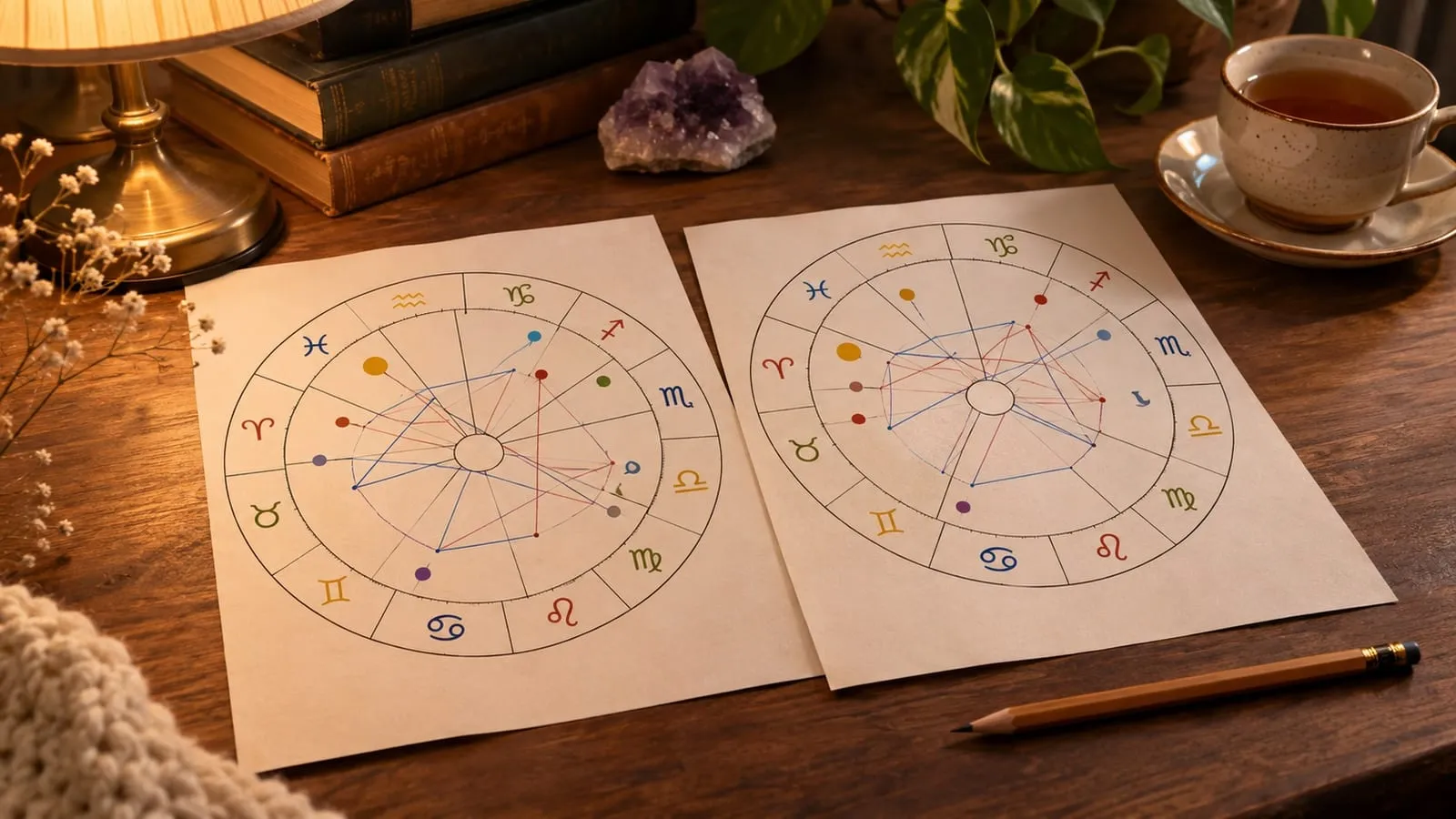
Soulmate astrology is the practice of comparing two people’s full birth charts to look for signs of a deep, fated bond. Astrologers call the comparison synastry. Instead of matching sun signs, they look at how one person’s planets and points fall on the other’s: the Sun and Moon, Venus and Mars, a calculated point called the Vertex, the asteroid Juno and the nodes of the Moon. Most of these need an exact birth time. And while astrology is a belief system, not a science, researchers have tested compatibility against real marriages. Below is what astrologers check, what each placement is said to mean, and what the research found.
Why sun signs are not enough
If you have read our guide to the soulmate by zodiac sign, you know the sun sign lists disagree with each other. Astrologers themselves say that is because a sun sign is one point out of many. Cafe Astrology’s page on soulmate astrology, read in October 2026, barely mentions sun signs and points instead to contacts between two whole charts.
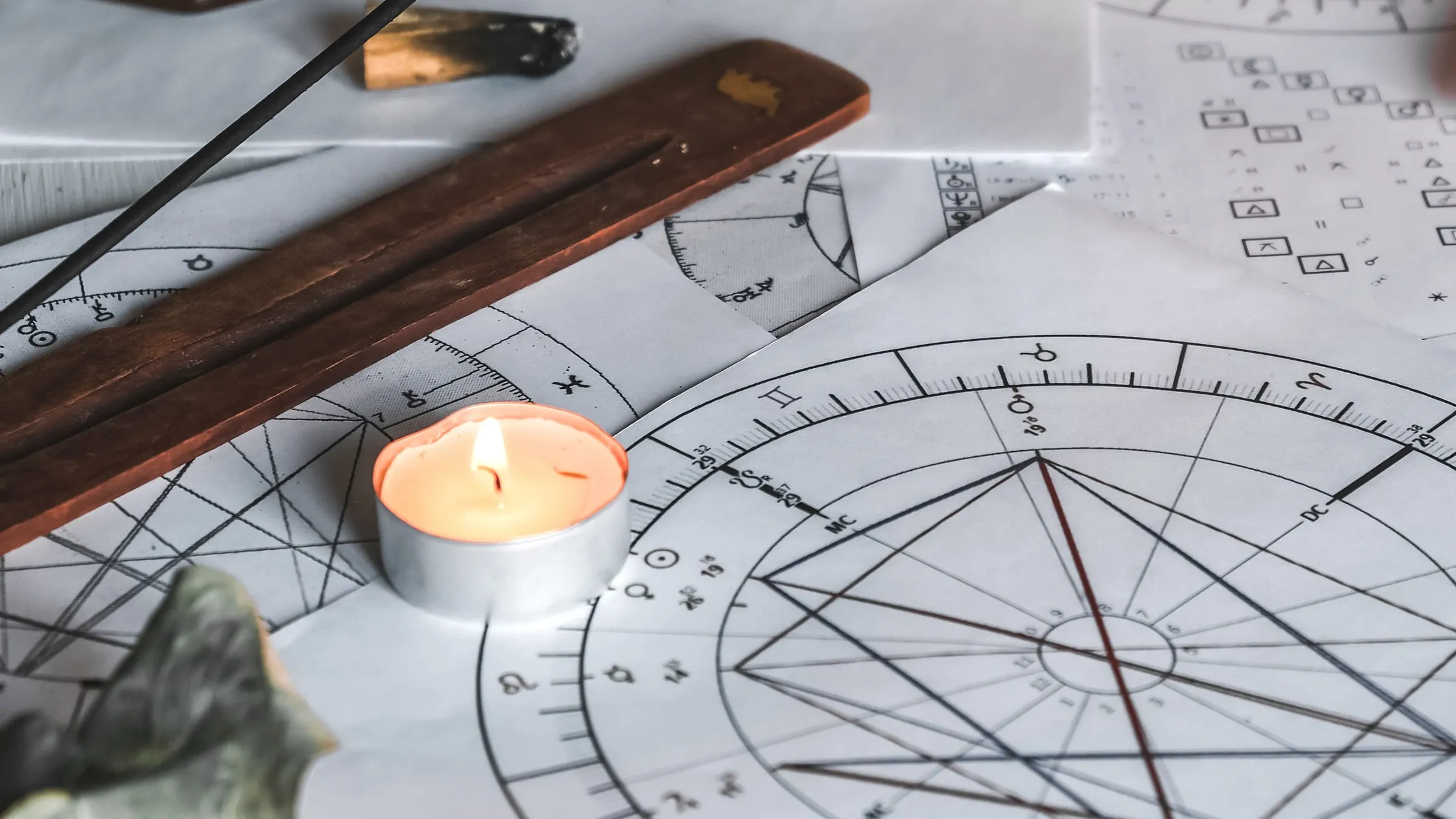
A full birth chart, as Britannica defines a horoscope, shows “the relative positions of the Sun, the Moon, the planets, and the ascendant and midheaven signs of the zodiac at a specific moment in time.” Two people born on the same day can have very different charts if they were born hours or places apart. That is why soulmate astrology starts with exact birth data.
What synastry is
Synastry is the comparison of two charts. Wikipedia’s entry on astrological compatibility begins: “Astrological compatibility (synastry) is the branch of the astrology” that studies relationships. In practice, an astrologer overlays one chart on the other and lists the angles, called aspects, between one person’s planets and the other’s.
Aspects in brief
Two planets in the same place (a conjunction) are read as merging. Opposite each other, as attraction and tension. At 120 degrees (a trine) or 60 degrees (a sextile), as ease. At 90 degrees (a square), as friction. Astrologers usually allow a few degrees either side, called an orb.
The placements astrologers check for soulmates
Sun and Moon
The pairing most often named is one person’s Sun with the other’s Moon. Cafe Astrology says: “When one partner’s Sun makes an aspect with the other’s Moon, there is a natural affinity.” In astrological terms the Sun is who you are and the Moon how you feel, so the contact is read as one person feeling understood by the other.
Venus and Mars
Venus is read as how you love, Mars as how you desire. Contacts between one person’s Venus and the other’s Mars are the classic sign of attraction in synastry. Mindbodygreen’s astrologer Imani Quinn, quoted in 2023, adds that “our Venus sign will heavily influence how we give and receive love.”
The Vertex
The Vertex is less well known and is the point most linked to fate. Cafe Astrology describes it as “a point located in the western hemisphere of a chart (the right-hand side)” that “represents the intersection of the ecliptic and the prime vertical.” It says “those who use the Vertex generally feel it is a point of karmic or fated connection,” while noting the meaning is debated. In synastry, the contact astrologers look for is when “one person’s personal planet or ASC conjuncts or opposes the other person’s Vertex,” usually within a couple of degrees.
The Vertex moves quickly through the chart, so it needs an exact birth time. Even astrologers are cautious about it. Under a 2007 post on the Vertex on Elsa’s astrology blog, one commenter wrote that she had “not seen strong enough significant statistical correlations, especially where other planets were not involved.”
Juno
Juno is an asteroid, discovered “on 1 September 1804, by Karl Ludwig Harding,” according to Wikipedia. Astrologers named its meaning after the goddess, Jupiter’s wife. LoveToKnow’s astrology writer Patricia Lantz says: “Astrologically, Juno represents marriage/partnership, what you need in a mate, and the kind of mate you’ll be,” and that “Juno is essential to consider in synastry.” She adds the usual caution: “As with everything in astrology, how Juno is expressed depends on the entire birth chart.”
The nodes of the Moon
The lunar nodes are two points where the Moon’s path crosses the Sun’s. In modern astrology the South Node is often linked to the past and the North Node to growth, so contacts to them are read as karmic or past-life ties. If that idea interests you, see our article on the past life soulmate belief.
The composite chart
Some astrologers go a step further and blend two charts into one, a composite chart, made of the midpoints between each pair of planets. Cafe Astrology says that “soulmates always have a powerful composite chart.”
Why most of this needs a birth time
Your Sun sign comes from your birthday. Almost everything else here does not. The Moon changes sign every two to three days, the Ascendant every two hours or so, and the Vertex just as fast. Cafe Astrology’s Vertex tool says it plainly: “If you know your birth time, you can determine the sign of your Vertex.” Without the time, an astrologer can compare Suns, Venus and Mars with confidence, and little else.
This matters for anything that promises a soulmate reading from a date alone, including ours. Our portrait uses your birthday (month and day, never the year) to find your sun sign for the short written reading. That is a playful touch, not a synastry chart.
What research found
Astrology is a belief system. Britannica puts it simply: “Astrology is not supported by science.” Compatibility, unusually, has been tested on real couples. Jonas Helgertz and Kirk Scott, in a 2020 paper in the journal Genus, used Swedish population register data from 1968 to 2001 to ask whether astrologically compatible couples marry more often or divorce less. Their conclusion: “The results fail to provide any consistent evidence” that they do.
Population registers record birth dates, not birth times, so a study like this can test date-based compatibility, not full synastry, and it covered one country. Astrologers would say it did not test what they actually do. But it is the largest test we know of, and it found nothing. So it is fair to enjoy synastry as a language for talking about a relationship, and unwise to use it to choose or leave one.
How to try it yourself
Get exact birth data for both people: date, time and place. A birth certificate often has the time.
Use any free chart site with a synastry or “relationship” option.
Look first at Sun with Moon, then Venus with Mars, then the Ascendant. Leave the Vertex and Juno for last; they are fine details.
Read the results as a conversation starter. If a contact sounds like the two of you, enjoy it. If it does not, nothing is wrong.
Where a portrait fits
Soulmate astrology works with two charts. If you have not met the second person yet, you only have one. We cannot tell you who will complete the pair, and we do not claim to. What we make is a picture of the kind of person you are drawn to, as a playful prompt.
The Soulmate Studio asks seven quick questions about what draws you to someone, where you feel at home and where your heart is right now, plus your birthday (month and day only). You get one portrait, created from your answers in our signature pencil-sketch style, with a short written reading. The face is imagined, not predicted, and it is not a real person. It is for entertainment and reflection.
Example portrait
A woman, 30s, at home on the coast, drawn to a warm laugh
There is no special chart for soulmates. Astrologers use your ordinary birth chart, calculated from your date, time and place of birth, and compare it with another person's. That comparison is called synastry. Some also look at one chart alone for placements linked to partnership, such as Venus, the seventh house, the Vertex and the asteroid Juno.
The Vertex is a calculated point on the right-hand side of a birth chart, not a planet. Astrologers who use it read it as a point of fated meetings. In synastry they look for one person's Sun, Moon, Venus or Ascendant sitting very close to the other's Vertex. It depends on an exact birth time, and its meaning is debated even among astrologers.
Juno is an asteroid discovered in 1804 and named after the Roman goddess, wife of Jupiter. In astrology it stands for marriage and long-term commitment. In synastry, astrologers look at whether one person's planets touch the other's Juno, and read close contacts as a sign of a committed bond. Like everything in a chart, they say, it is read alongside the rest.
A calculator can draw two charts and list the contacts between them accurately; that part is just astronomy. What it cannot do is tell you whether someone is your soulmate, because the meanings are a belief system. A large Swedish study found no consistent link between astrological compatibility and marriage or divorce. Use one as a game.
Your soulmate sketch
Curious what your own answers might imagine?
Answer seven quick questions about what you notice first and where you feel at home. We turn your answers into a pencil portrait of the person they describe, sealed with a short letter written from your birthday and your choices. Imagined, for entertainment, not a prediction.
$19, paid once, no subscription
In your inbox, usually within minutes and always within 24 hours
Our method has been reviewed and approved by an independent practicing psychic we commissioned.
For entertainment. The person in the portrait is imagined, not predicted.
Dear Aries,
The first thing that comes through is how he climbs a shingle beach at low tide with a dented orange buoy under one arm, shirt open at the collar and stiff with salt, brown hair shoved in every direction by a wind he has not bothered to argue with. The faded paint on the buoy spells out a house name, Slack Tide, and he has decided it is going home tonight.
No sign is anyone's official soulmate. What astrology has is a wheel, four elements and a few angles, and from those every sign gets the same short list of matches.
Nobody can put a date on meeting a person, and that includes us. What you can get is a clearer idea of what you are waiting for.
Read the article
May we count visits to see where people stop in the quiz? If you allow it, we use Google Analytics, which sets cookies. Nothing is shared with advertisers. Privacy